Essential Power Tools for Homesteaders: What to Buy First
Tool acquisition advice for homesteaders is frequently given by either shop woodworkers (who prioritize precision over practicality) or contractors (who need commercial-grade durability at a price point a homesteader cannot justify). Neither group is building raised beds, compost bins, coops, cold frames, and garden trellises on a realistic homestead budget.
Here is the sequence of tool purchases that builds genuine homestead capability efficiently, with specific recommendations and the honest reasoning for each.
Buy These First: The Core Eight
1. Drill-Driver (Buy This Before Anything Else)
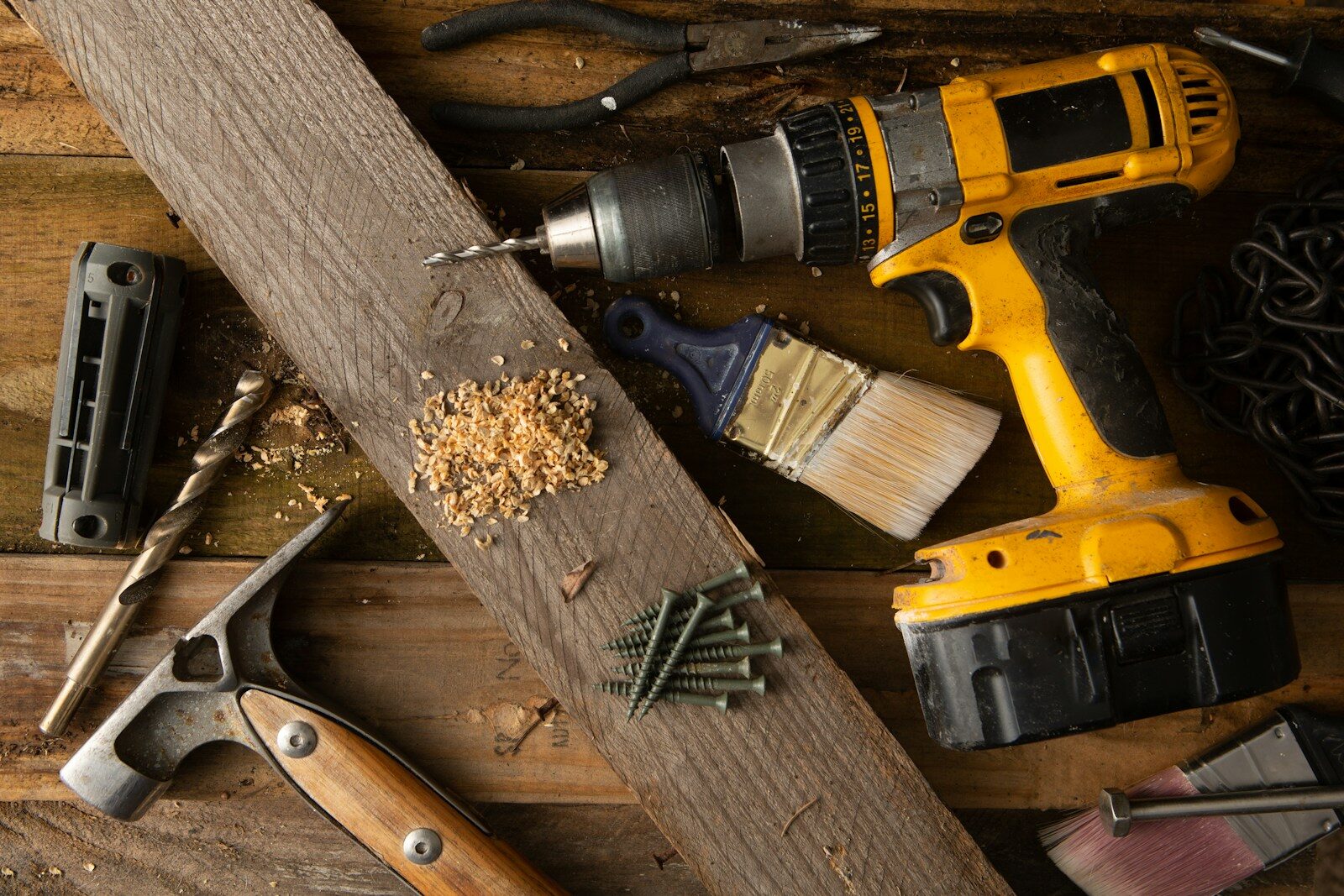
A cordless drill-driver is the single most used power tool on a homestead. It drives screws into every assembled project, drills holes for hardware installation, mixes paint and finishes with a paddle attachment, and handles dozens of tasks that arise outside of woodworking.
The drill-driver establishes your battery platform. Choose a major brand’s battery system (Milwaukee M18, DeWalt 20V MAX, Makita 18V LXT, or Ryobi ONE+) and then buy subsequent cordless tools in that same system so batteries are interchangeable.
For a homestead that will use tools hard, Milwaukee M18 and DeWalt 20V MAX both offer the best combination of tool selection, battery performance, and longevity. The M18 Compact Drill-Driver kit with two 2.0Ah batteries runs $100 to $130 and handles all homestead drill-driver tasks.
For a budget-first approach, Ryobi ONE+ has the largest selection of 18-volt tools at the lowest price point. Tool quality is lower than Milwaukee or DeWalt but adequate for homestead use. The ONE+ drill-driver kit with two batteries typically runs $60 to $80.
Milwaukee M18 drill-driver compact kit
DeWalt 20V MAX drill-driver kit
Ryobi ONE+ 18V drill-driver kit budget option
2. Circular Saw
As covered in our best circular saw for beginners guide, a 7-1/4-inch corded saw in the 15-amp range handles all dimensional lumber cutting for homestead projects. The DeWalt DWE575 is the recommendation; the Ridgid R3205 is the budget option.
If you chose Milwaukee M18 as your battery platform, the M18 FUEL circular saw allows sharing batteries with your drill-driver and eliminates cord management on outdoor sites.
3. Jigsaw
A jigsaw handles curved cuts that a circular saw cannot: the arc at the corner of a coop access door, the circular opening for a birdhouse gourd mounting board, the notch that lets a shelf fit around a corner post, the curved top of a garden gate. Every homestead project has at least one cut where a circular saw cannot go.
A mid-range jigsaw with variable speed and orbital action from Bosch, DeWalt, or Milwaukee handles all of these applications well. Bosch jigsaws in particular are noted for smooth operation and blade change mechanisms that do not require tools.
DeWalt 20V cordless jigsaw kit if staying with the DeWalt platform.
4. Random Orbit Sander
Projects that will be painted, stained, or have visible surfaces benefit from sanding that a random orbit sander accomplishes efficiently. A 5-inch random orbit sander in the $40 to $70 range handles the sanding work on coop trim, raised bed caps, and any piece that will be a visible finished surface.
This tool is less urgent than the first three but earns its place quickly once you start finishing projects with paint or sealer.
DeWalt 5-inch random orbit sander
Makita 5-inch random orbit sander
5. Impact Driver
An impact driver is distinct from a drill-driver. A drill-driver rotates with consistent torque, appropriate for drilling holes and driving screws with precision. An impact driver delivers rotational force in hammering impulses that drive large fasteners into dense or hard materials with much less effort and without the wrist-twisting feedback that a drill-driver produces when a large screw suddenly tightens.
For driving 3-inch deck screws into pressure treated lumber, lag screws into posts, and structural fasteners into framing, an impact driver makes the work dramatically easier on your wrists and arms.
Buy an impact driver in the same battery platform as your drill-driver. Running them side by side, with the drill-driver loaded with a drill bit and the impact driver loaded with a screw bit, eliminates the constant bit-swapping that slows down project assembly.
6. Reciprocating Saw
A reciprocating saw (Sawzall is Milwaukee’s brand name but is used generically) cuts through materials in confined spaces where no other saw fits: cutting a post off at ground level, trimming a root that is in the way of a coop foundation, opening a wall in an existing structure, cutting through a nail-embedded old board that would damage a circular saw blade.
This tool is not in the first three you need, but once you own one it is used constantly for the cut-in-place trimming tasks that arise on every project site.
Milwaukee M18 FUEL reciprocating saw
DeWalt 20V MAX reciprocating saw
7. Miter Saw
A miter saw (also called a chop saw) makes accurate crosscuts at precise angles quickly. It is the tool that makes cutting multiple pieces to the same length fast and consistent: all the rafters for a coop at exactly the same length, all the boards for a raised bed at exactly 45 inches, all the balusters for a fence at exactly the same height.
A miter saw does not expand what you can build; it makes building it faster. A circular saw with a speed square can make every cut a miter saw makes, just more slowly and with more individual measurement. For a homesteader building occasional large projects, a circular saw is adequate. For a homesteader who builds continuously, a miter saw saves hours over a season.
A 10-inch compound miter saw from DeWalt, Milwaukee, or Makita handles homestead project work comprehensively. Sliding compound miter saws add the ability to crosscut wide boards, which is useful for cutting 12-inch wide lumber.
DeWalt 10-inch compound miter saw
Makita 10-inch sliding compound miter saw
8. Router
A router shapes edges, cuts grooves, makes dadoes, and creates the decorative edge profiles that make finished projects look more refined. On a homestead, the most practical applications are rounding over the sharp edges on roost bars (which hens grip better when slightly rounded), making dadoes for shelf construction in storage buildings, and edge-profiling lumber that will be visible on finished exterior structures.
A plunge router in the 1.75 to 2.25 horsepower range handles all standard homestead routing applications. Router bits are sold separately and a set of the most common profiles (roundover, chamfer, straight, cove) covers most practical applications.
Bosch 1617EVS router kit is one of the most consistently recommended mid-range routers.
Tools That Can Wait
Table saw: Extremely useful for making consistent rip cuts through sheet goods and long boards. Not necessary for the first 20 homestead projects, which can all be accomplished with a circular saw and a straightedge guide. When you find yourself regularly ripping multiple boards to the same width, a table saw becomes worthwhile.
Thickness planer: A planer mills rough lumber to a consistent thickness. For homestead projects using dimensional lumber from a lumber yard, a planer is unnecessary. The lumber arrives at consistent thickness. Planer purchases make sense when buying rough-sawn timber from a mill and needing to mill it yourself.
Band saw: A band saw makes curves in thick material and resaws boards (cutting a thick board into two thinner ones). Neither application comes up commonly in standard homestead woodworking. The jigsaw handles most curved cuts adequately.
Drum sander: A drum sander flattens large panels consistently. Useful in fine woodworking shops. Rarely needed in homestead project work.
Hand Tools Worth Owning Alongside Power Tools
A set of chisels in common widths (1/4, 1/2, 3/4, and 1 inch) for paring wood, cleaning up joints, and any fit work that power tools cannot reach.
A quality hand saw for cuts in tight spaces or on job sites without power.
A hammer for driving stakes, nails in tight spaces, and general persuasion of lumber.
A mallet for driving chisels and fitting joints without damaging tool handles.
Narex chisel set 4-piece is the most recommended beginner-to-intermediate chisel set.
Japanese-style pull saw cuts on the pull stroke, making controlled cuts in confined spaces easier.