Best Paints and Finishes for Decorative Gourds: What Works and What Does Not
Choosing the wrong finish on a gourd that took hours to carve or burn is one of the more discouraging experiences in gourd art. Some products do not adhere properly to gourd shell. Some finishes obscure carved detail that was the point of the work. Some sealers yellow over time or crack as the gourd shell moves slightly with humidity changes.
Here is a clear breakdown of what works, what each product does, and specific product recommendations.
Understanding Gourd Shell as a Surface
Before choosing a finish, it helps to understand what you are applying it to. Cleaned, dried gourd shell is a dense, slightly porous surface that is neither wood nor typical ceramics nor plastic. It absorbs some liquid finishes but not as readily as bare wood. It has a slight natural sheen from the outer surface layer.
Different finishing products interact with this surface differently. Some penetrate into the shell structure. Some sit on the surface and film over. Some require the shell to be sanded or prepared before they adhere consistently.
The other variable that affects finish choice is whether the gourd has been carved, burned, painted with undercoat, or is being worked on a natural shell. Carved surfaces have exposed interior shell material that is more porous. Burned surfaces have a slightly different surface chemistry from the heat application. Both interact with finishes somewhat differently than unworked shell.
Leather Dye: The Best Option for Natural Color with Visible Detail
Leather dye penetrates the gourd shell and colors it from within rather than sitting on top of the surface. This makes it ideal for carved or burned gourds where you want the surface detail to remain visible and dimensional after coloring.
Because leather dye is transparent and penetrating, it shows the natural variation in gourd shell surface through the color. Areas where the shell is denser take the dye slightly differently than more porous areas, creating a natural, non-uniform color that looks organic and handmade in the best sense.
Leather dye also works exceptionally well when layered. A base coat of brown, allowed to dry fully, followed by black applied in recessed carved areas, produces depth and contrast that makes carved designs more dramatic.
Products that work:
Fiebing’s leather dye is the most widely used brand in gourd art. It comes in a wide color range, penetrates gourd shell consistently, and dries to a consistent finish. Available in bottles at leather craft stores or online.
Fiebing’s leather dye set for gourd art
Indian shoe polish dye, often sold as Griffin shoe dye, is a related product that works similarly on gourd shell. It is available in a narrower color range but is widely stocked.
Application: Apply with a sponge, foam brush, or cloth. Work in sections and blend edges before the dye dries. Leather dye dries relatively quickly and does not allow long working time for blending. Multiple thin coats build color more consistently than one heavy coat.
Sealer required: Leather dye alone does not protect the gourd surface from moisture or handling. Always seal over leather dye when the dye is fully dry.
Acrylic Paint: Versatile and Widely Available
Acrylic paint is opaque, versatile, available in every color, and adheres to gourd shell without primer if the shell is clean and oil-free. It is the most beginner-friendly finish for painted decorative pieces where color coverage matters more than showing the natural shell surface.
For carved gourds, acrylic applied before carving can be carved through to reveal the natural shell beneath, creating a distinctive two-layer color effect. Applied after carving, acrylics fill the recessed carved areas with color and contrast with painted surface areas.
Artist-grade acrylics (Liquitex, Golden, M. Graham) produce more consistent coverage and richer color than craft-grade acrylics at the cost of higher price. For detailed or fine art gourd work where color accuracy matters, artist-grade products are worth the difference. For general craft work, craft-grade acrylics perform adequately.
Golden heavy body acrylic paint set for artist-quality work.
Craft smart acrylic paint set for general crafting at lower cost.
Application: Thin acrylics slightly with water for smooth application on gourd shell. Undiluted acrylic can show brush strokes more prominently than thinned paint. Multiple thin coats produce better results than one heavy coat.
Dry time: Most acrylics are touch-dry within thirty minutes but require 24 hours for full cure before applying sealer or additional coats.
Oil-Based Stains: Rich Natural Color for Carved Work
Oil-based wood stains penetrate and color gourd shell in a way similar to leather dye but with a broader range of wood-tone colors that are particularly attractive on carved and burned pieces where an organic, natural aesthetic is the goal. Walnut, cedar, mahogany, and ebony stains on carved gourd shell produce beautiful results.
Oil-based stains require longer drying time than water-based products, typically 24 to 48 hours between coats. They also require mineral spirits for cleanup. The tradeoff for these inconveniences is deeper penetration and richer color than water-based stains.
Minwax oil-based stains work well on gourd shell after a light sanding with 220-grit paper to open the surface slightly.
Minwax oil-based stain set provides a range of wood tones that work beautifully on gourd.
Sealers: The Final Layer That Protects Everything
Every painted, dyed, or stained gourd needs to be sealed. An unsealed gourd collects dust in carved areas, shows fingerprints, and is vulnerable to moisture if handled or displayed in humid conditions. The sealer also determines the sheen level of the finished piece, from completely matte to high gloss.
Spray polyurethane is the most durable sealer for decorative gourd art and is available in matte, satin, and gloss finishes. Apply in light, even coats from about twelve inches away. Two to three coats produce adequate protection. Three coats is appropriate for pieces that will be handled frequently or displayed outdoors.
Minwax polycrylic spray sealer for crafts is a water-based option that does not yellow over time and applies over acrylics without dissolving them.
Rust-Oleum clear gloss spray is a solvent-based option that produces a very durable finish and is appropriate for outdoor-displayed pieces.
Wax finishes produce a soft, hand-rubbed look that is natural-feeling and beautiful on natural shell or leather-dyed gourds. The limitation is durability: wax is not as protective as polyurethane and requires reapplication periodically. For decorative pieces that will be handled gently, wax is elegant. For functional pieces or anything that will be touched often, use polyurethane.
Renaissance Wax is the museum conservation standard and works beautifully as a gourd finish.
Tung oil produces a deep, hand-rubbed finish that penetrates the shell and adds a warm amber tone to natural or stained surfaces. It does not build a film like polyurethane but provides water resistance. Multiple coats, applied and wiped off before drying fully, build toward a beautiful finish that feels like part of the shell rather than sitting on top of it.
Waterlox original tung oil sealer is a quality product for this technique.
Finishing a Carved and Burned Gourd: Recommended Process
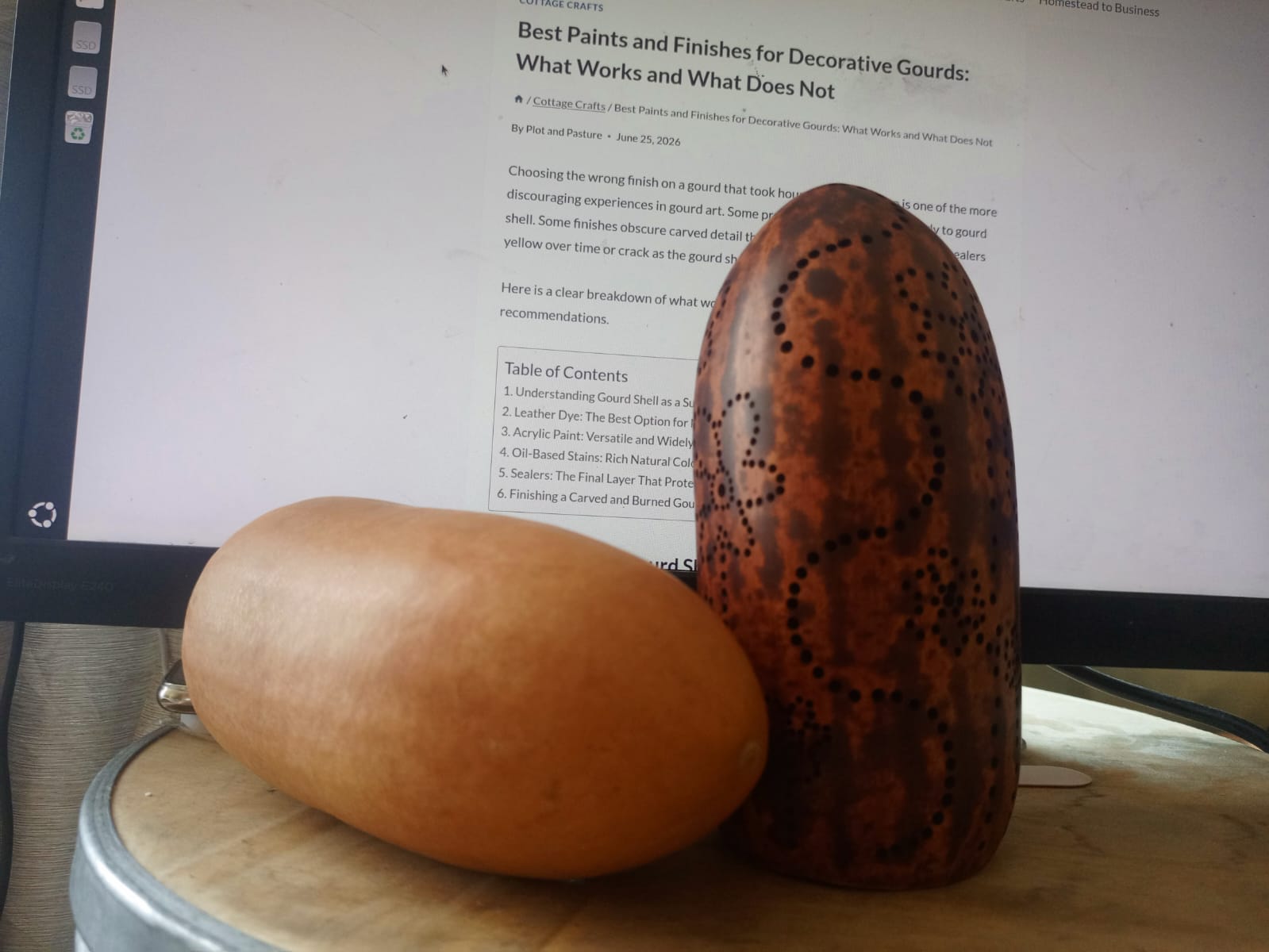
For a gourd that has both carving and pyrography:
- Complete all carving and burning before applying any finish.
- Remove any pencil or transfer paper marks with a soft eraser.
- Apply leather dye or acrylic wash if color is part of the design.
- Allow to dry completely, minimum 24 hours.
- Apply two to three coats of matte or satin spray polyurethane, allowing full dry time between coats per the product label.
- If additional sheen is wanted, buff lightly with 0000 steel wool between final coats for a smoother finish.
For more on creating the carved and burned surface that you are finishing, see gourd art for beginners, best Dremel bits for gourd carving, and pyrography on gourds.